I've been struggling with reading Moby Dick by Herman Melville. I was never assigned the novel in High School or even as an English Major in Undergrad and Grad school. And I never had any interest. But since my good friend Mark is currently working on a project of which Moby Dick is significantly influential, so I decided to give it a go and added it to my Classics Club Challenge list.
I'm currently on chapter 58 and I'm struggling. There are 136 chapters and I am not quite far enough into the text to power through. I'm languishing. I asked my friend Mark for help. He told me that the book is very flawed and is in need of editing which it didn't receive before it was published. It's disjointed, there are chapters that can be taken out and it was not how Melville intended it to be. Knowing that helps a bit.
Blogger Jill from A Room of One's Own [Update: blog is now defunct] posted about a new online event called Moby Dick Big Read. It started a couple days ago. Each day they post an audio clip of one full chapter being read by a different actor or narrator. They also post some relevant art material. It's such a genius idea! I would have to wait until 11/12 in order to get to the point where I'm at in the book to start the project. I might wait until they get to chapter 50 instead of chapter 58 because the last few chapters I read of Moby Dick didn't quite sink in. Or I might start even earlier! Who knows. The project would be complete by January of 2013. I wanted to finish Moby Dick by the end of this month but I don't think this is the kind of book to be rushed.
Are you going to participate in Moby Dick Big Read?
Questionnaire on Reading & Books - September 2012
I saw this questionnaire on Boston Bibliophile as part of Book Blogger Appreciation Week. I thought I'd use the same questionnaire for here!
Do you snack while you read? If so, favorite reading snack?
I don't eat while I read. I make a point not to as I think eating and reading should be savored separately. Doing both at the same time you can't fully appreciate one or the other.
Do you tend to mark your books as you read, or does the idea of writing in books horrify you?
I hate marking books. I avoided it in college. One time I had to mark up a biography about the three Roosevelts. I used pencil but I hated the experience so much. That poor book! I am still traumatized by the experience. I'd rather make notes on separate pieces of paper with page #s and leave the papers inside the book for future reference.
How do you keep your place while reading a book? Bookmark? Dog-ears?
Bookmark. I'll use anything. Receipts, business cards, empty envelopes, etc. I would never dog-ear a book.
Laying the book flat open?
I live to preserve the spine so I don't do that. I used to work in a bookstore and had to talk to a customer. She spent the entire time opening the spine of a brand new book she didn't even buy. It was quite horrifying. I guess I'm particular about books. :-)
Fiction, Non-fiction, or both?
Non-fiction and fiction is only classics now. I've been dealing with a lot of issues when it comes to Fiction. I just don't find the joy in it I used to. In fact, fiction just angers me right now. I'm not sure what to do about it.
Hard copy or audiobooks? or ebooks?
All of the above. I love hard copies the best but there is nothing quite like a well-narrated audio book. Ebooks are okay but I don't own a eReader. I do use one for work and that's how I read manuscripts and ARCs. Otherwise, I'm more of a hard copy or audio kind of gal.
Are you a person who tends to read to the end of chapters, or are you able to put a book down at any point?
I have to be able to put down a book at any point. I don't like it but I have to cram in reading whenever I can and sometimes that means only a page or two. I try to read during my lunch breaks at work and at that point I try to finish at least a whole chapter.
If you come across an unfamiliar word, do you stop to look it up right away?
Yes. It becomes a bit cumbersome when reading classics. Especially Thomas Hardy!
What are you currently reading?
The Language Instinct: How the Mind Creates Languages by Steven Pinker (I love linguistics)
The Passage of Power: The Years of Lyndon Johnson Book #4 by Robert A. Caro(This book just fascinates me.)
Ogilvy on Advertising by David Ogilvy (I love Mad Men and do some advertising for a living. Want to learn more about it)
Moby Dick by Herman Melville (for the Classics Club challenge)
Nolo's Essential Guide to Buying Your First Home by Various(we are in the process of buying a new home)
What is the last book you bought?
The Passage of Power: The Years of Lyndon Johnson Book #4 by Robert A. Caro - I saw it at a Barnes & Noble and I just had to have it.
Are you the type of person that only reads one book at a time or can you read more than one at a time?
I never read one book at a time. If I did, I'd go crazy. I need several books going at once. I try to read one book for fun, one book for learning and one book for work. But sometimes that doesn't happen. Right now, I'm trying to make sure that I always have one classic novel going so I can keep on track for my Classics Club challenge of reading 50 classics in 5 years.
Do you have a favorite time of day and/or place to read?
I like to read in my car during my lunch break. It's nice quiet time. It's tricky during the summer because my car gets hot!
Do you prefer series books or stand alone books?
Stand-alone books. I'm almost never compelled to read books in a series. If it's a trilogy, maybe, but not a series.
Is there a specific book or author that you find yourself recommending over and over?
Not really. I like to recommend books based on specific people and circumstances. One book I really loved might not be well received by a lot of people. I do have a talent of placing a particular book with the right person.
How do you organize your books? (By genre, title, author’s last name, etc.?)
As you can see above, I'm reading a book about buying a new home. We live in a small 2 bedroom condo and a lot of books are in storage. The books I do have out are organized by subject. I have 2 shelves of classic film books, 1 shelf of cookbooks, 1 shelf of literary fiction, 1 tiny shelf of children's books, etc. I have one shelf devoted to books I haven't read and want to read soon. My TBR shelf!
Do you snack while you read? If so, favorite reading snack?
I don't eat while I read. I make a point not to as I think eating and reading should be savored separately. Doing both at the same time you can't fully appreciate one or the other.
Do you tend to mark your books as you read, or does the idea of writing in books horrify you?
I hate marking books. I avoided it in college. One time I had to mark up a biography about the three Roosevelts. I used pencil but I hated the experience so much. That poor book! I am still traumatized by the experience. I'd rather make notes on separate pieces of paper with page #s and leave the papers inside the book for future reference.
How do you keep your place while reading a book? Bookmark? Dog-ears?
Bookmark. I'll use anything. Receipts, business cards, empty envelopes, etc. I would never dog-ear a book.
Laying the book flat open?
I live to preserve the spine so I don't do that. I used to work in a bookstore and had to talk to a customer. She spent the entire time opening the spine of a brand new book she didn't even buy. It was quite horrifying. I guess I'm particular about books. :-)
Fiction, Non-fiction, or both?
Non-fiction and fiction is only classics now. I've been dealing with a lot of issues when it comes to Fiction. I just don't find the joy in it I used to. In fact, fiction just angers me right now. I'm not sure what to do about it.
Hard copy or audiobooks? or ebooks?
All of the above. I love hard copies the best but there is nothing quite like a well-narrated audio book. Ebooks are okay but I don't own a eReader. I do use one for work and that's how I read manuscripts and ARCs. Otherwise, I'm more of a hard copy or audio kind of gal.
Are you a person who tends to read to the end of chapters, or are you able to put a book down at any point?
I have to be able to put down a book at any point. I don't like it but I have to cram in reading whenever I can and sometimes that means only a page or two. I try to read during my lunch breaks at work and at that point I try to finish at least a whole chapter.
If you come across an unfamiliar word, do you stop to look it up right away?
Yes. It becomes a bit cumbersome when reading classics. Especially Thomas Hardy!
What are you currently reading?
The Language Instinct: How the Mind Creates Languages by Steven Pinker (I love linguistics)
The Passage of Power: The Years of Lyndon Johnson Book #4 by Robert A. Caro(This book just fascinates me.)
Ogilvy on Advertising by David Ogilvy (I love Mad Men and do some advertising for a living. Want to learn more about it)
Moby Dick by Herman Melville (for the Classics Club challenge)
Nolo's Essential Guide to Buying Your First Home by Various(we are in the process of buying a new home)
What is the last book you bought?
The Passage of Power: The Years of Lyndon Johnson Book #4 by Robert A. Caro - I saw it at a Barnes & Noble and I just had to have it.
Are you the type of person that only reads one book at a time or can you read more than one at a time?
I never read one book at a time. If I did, I'd go crazy. I need several books going at once. I try to read one book for fun, one book for learning and one book for work. But sometimes that doesn't happen. Right now, I'm trying to make sure that I always have one classic novel going so I can keep on track for my Classics Club challenge of reading 50 classics in 5 years.
Do you have a favorite time of day and/or place to read?
I like to read in my car during my lunch break. It's nice quiet time. It's tricky during the summer because my car gets hot!
Do you prefer series books or stand alone books?
Stand-alone books. I'm almost never compelled to read books in a series. If it's a trilogy, maybe, but not a series.
Is there a specific book or author that you find yourself recommending over and over?
Not really. I like to recommend books based on specific people and circumstances. One book I really loved might not be well received by a lot of people. I do have a talent of placing a particular book with the right person.
How do you organize your books? (By genre, title, author’s last name, etc.?)
As you can see above, I'm reading a book about buying a new home. We live in a small 2 bedroom condo and a lot of books are in storage. The books I do have out are organized by subject. I have 2 shelves of classic film books, 1 shelf of cookbooks, 1 shelf of literary fiction, 1 tiny shelf of children's books, etc. I have one shelf devoted to books I haven't read and want to read soon. My TBR shelf!
Classic Hollywood Style by Caroline Young
Classic Hollywood Style
by Caroline Young
October 2012
224 pages
Hardcover ISBN 9780711233751
Frances Lincoln
This review originally appeared on my classic film blog Out of the Past.
I cannot tell you how many times someone has come up to me to tell me that my outfit looks like something from an old movie. Or they point out something I would like because it's old Hollywood style. I just really love the fashion (as well as the design) of classic movies. So, a book like Caroline Young's Classic Hollywood Style is right up my alley.
Caroline Young's background is in Literature, Film and Journalism but her love and appreciation of classic Hollywood fashion is quite evident in this book. She takes a look at 34 films starting with Camille (1921) and ending with The Thomas Crown Affair (1968). Other notable films include Gone With the Wind (1939), Casablanca (1942), Gilda (1946), The Seven Year Itch (1955) and Breakfast at Tiffany's (1961). There is a nice mix of popular films as well as some lesser known ones. There are 3 films from the 1920s, 7 films from the 1930s, 8 films from the 1940s, 11 films from the 1950s and 4 films from the 1960s. Each movie gets 3 spreads, 6 pages total with a couple movies getting an extra spread, 2 pages. There are many full page images but the focus really is on the text. Young explores the decision making of the fashion, the relationship between designer and star, the cultural influence of the film's fashion as well as the role the fashion plays in each film.
This book is nice and compact and is beautiful enough to serve as a small coffee table book but can easily be shelved as well. Basically, you want to read the book, not just look at the pretty pictures. The book is chockfull of great anecdotes and trivia bits. It's a really good choice for someone who is either into fashion or into classic films or both. There are no spoilers so if you haven't watched one of the films discussed then the movie won't be ruined for you. There were only a couple films I wasn't interested in but for the most part each film was a delight to read about. I hadn't realized how iconic certain outfits really are and how we identify certain films by those very outfits. The wife-beater on Marlon Brando, the white negligee on Elizabeth Taylor, the red windbreaker on James Dean, the white flowing dress on Marilyn Monroe, the green curtain dress on Vivien Leigh, etc. I don't even need to mention which outfit went with what film. You automatically know what it was just by the image.
I thought it was interesting that Young decided to end the list with 1968 when the Hays Code was put to an end. Young claims that with the end of the Hays Code there was a more towards realism because now filmmakers had more freedom to show what they wanted on screen. So the lack of realism in designer fashioned masterpieces didn't fit the new era of film. Designers became more like shoppers rather than artists. This is why fashion in film these days isn't as important as it was back then and why so many of us mourn for the style of old Hollywood.
My biggest issue with the book was a glaring error found in the section about The Dancing Lady (1933) with Joan Crawford. Young says "... in the 1930s she was the reigning queen of MGM." Oh hell no! You did NOT just diss the real 1930s Queen of MGM who was...
by Caroline Young
October 2012
224 pages
Hardcover ISBN 9780711233751
Frances Lincoln
This review originally appeared on my classic film blog Out of the Past.
I cannot tell you how many times someone has come up to me to tell me that my outfit looks like something from an old movie. Or they point out something I would like because it's old Hollywood style. I just really love the fashion (as well as the design) of classic movies. So, a book like Caroline Young's Classic Hollywood Style is right up my alley.
Caroline Young's background is in Literature, Film and Journalism but her love and appreciation of classic Hollywood fashion is quite evident in this book. She takes a look at 34 films starting with Camille (1921) and ending with The Thomas Crown Affair (1968). Other notable films include Gone With the Wind (1939), Casablanca (1942), Gilda (1946), The Seven Year Itch (1955) and Breakfast at Tiffany's (1961). There is a nice mix of popular films as well as some lesser known ones. There are 3 films from the 1920s, 7 films from the 1930s, 8 films from the 1940s, 11 films from the 1950s and 4 films from the 1960s. Each movie gets 3 spreads, 6 pages total with a couple movies getting an extra spread, 2 pages. There are many full page images but the focus really is on the text. Young explores the decision making of the fashion, the relationship between designer and star, the cultural influence of the film's fashion as well as the role the fashion plays in each film.
This book is nice and compact and is beautiful enough to serve as a small coffee table book but can easily be shelved as well. Basically, you want to read the book, not just look at the pretty pictures. The book is chockfull of great anecdotes and trivia bits. It's a really good choice for someone who is either into fashion or into classic films or both. There are no spoilers so if you haven't watched one of the films discussed then the movie won't be ruined for you. There were only a couple films I wasn't interested in but for the most part each film was a delight to read about. I hadn't realized how iconic certain outfits really are and how we identify certain films by those very outfits. The wife-beater on Marlon Brando, the white negligee on Elizabeth Taylor, the red windbreaker on James Dean, the white flowing dress on Marilyn Monroe, the green curtain dress on Vivien Leigh, etc. I don't even need to mention which outfit went with what film. You automatically know what it was just by the image.
I thought it was interesting that Young decided to end the list with 1968 when the Hays Code was put to an end. Young claims that with the end of the Hays Code there was a more towards realism because now filmmakers had more freedom to show what they wanted on screen. So the lack of realism in designer fashioned masterpieces didn't fit the new era of film. Designers became more like shoppers rather than artists. This is why fashion in film these days isn't as important as it was back then and why so many of us mourn for the style of old Hollywood.
My biggest issue with the book was a glaring error found in the section about The Dancing Lady (1933) with Joan Crawford. Young says "... in the 1930s she was the reigning queen of MGM." Oh hell no! You did NOT just diss the real 1930s Queen of MGM who was...
Norma Shearer!
Norma Shearer WAS the Queen of MGM. That was her actual title. Movie stars were often given titles or tag lines that were used in the promotion of their movies. Norma Shearer was Queen of MGM, Clark Gable was King of Hollywood, Sterling Hayden was "The Most Beautiful Man in Movies", etc. Norma Shearer was the Queen of MGM and no matter how much this author loves Joan Crawford it's not going to change the fact that Joan Crawford hated Norma Shearer because Shearer was the Queen and Crawford wanted the title for herself. The author tends to favor Joan Crawford featuring her more times in the book than any other actress. Joan Crawford was very influential to fashion with the clothes she wore on film. It was quite common for stores to start carrying Joan Crawford inspired pieces for the masses. However, NORMA SHEARER WAS STILL THE QUEEN OF MGM!
There were a couple other instances of the author making similar statements but the others seemed more based on fact rather than this Joan Crawford one. There were no Norma Shearer movies in the book. While Norma Shearer wore amazing clothes I don't think she was as influential in fashion as Joan Crawford so I understand her absence. But I'm still offended by the statement.
However, the book is very well-researched with an appendix full of sources including interviews, newspaper articles, press releases, biographies, production notes, etc. Let's just hope that the author and publisher can fix that Joan Crawford line to read "in the 1930s she was one of the biggest stars of MGM" which would have been more accurate.
If you love Classic Hollywood fashion and are willing to overlook the Norma Shearer-Joan Crawford gaffe, then pick up this book! It's quite a treat.
Disclosure: Thank you to Frances Lincoln Limited Publishers for a review copy of the book
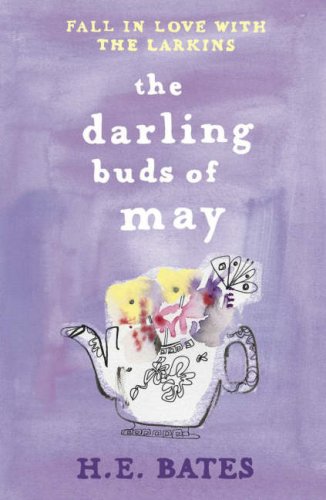
The Darling Buds of May by H.E. Bates
The Darling Buds of May
by H.E. Bates
An innocent tax collector visits the home of a family of tax-evaders in rural England. He has no clue what he is getting into. Will he make it out of the home alive? Or will he stay in their clutches forever?
You could spin the concept of the book as a dramatic thriller. But really The Darling Buds of May by H.E. Bates is one of the most charming novels you'll ever read. It follows the story of Charlie (Cedric Charlton) a young man who works for the local tax office. He's been sent out to the Larkin's home in Kent to talk about their taxes. Or for that matter, the income taxes they've never paid. Ever.
A visit that was only supposed to last a couple hours ends up lasting an entire month with Larkin's luring him in to their country ways. There is Pa Larkin, a farmer who knows how to barter and to mix a very strong cocktail. His income primarily comes from trading goods. In fact, he's not sure what income really is. To him it's all "out"come! The Larkin's are very well-fed bunch, feasting on full English breakfasts, desserts and heavy dinners. Not to mention all the alcohol. Make sure you don't read the book on an empty stomach or you might start salivating.
The book starts when Ma Larkin tells Pa Larkin that their eldest daughter Mariette (of 5 children) is pregnant. And not only is it out-of-wedlock, Mariette can't figure out who the father is. That's pretty darn scandalous even for today. But the Larkin's are free-thinkers and don't care to judge their daughter. Pa thinks it's purrfec' (his favorite word) either way.
When Charlie comes to visit the Larkin's have a dilemma. They like the guy but they don't want to pay taxes. A series of events that both charm and confuse Charlie send him on a whirlwind. He's stuffed with food, given too much alcohol and the beautiful and nubile Mariette is hypnotizing him. The novel introduces you to a lovely bunch of characters and a look into the charmed world of the Larkin's.
What impresses me about H.E. Bates' novel is how seemingly innocent it is. For a moment, you are entranced, much like Charlie is, with the family and their unconventional ways that you forget what society told you was wrong and you just have fun. When you read this, you want to move in with the Larkin's! I love Bates' prose. He refers to the romantic elements of nature in the prose to enhance the bucolic setting. I love the last line in which the four main characters are looking out the window onto the property while listening to the nightingales in the background.
There really is no plot or rising action in the book. It's really just a slice of life kind of tale. You follow their adventures. The only real tension one can find in the book is whether Charlie will leave the Larkin's or if they will convince him to stay.
I first became familiar with the story of the Larkin's and Charlie through the British TV mini-series from the early 1990s by the same name. Each part of the mini-series is devoted to one of the 5 books in the Larkin family series. I have to say, I'm impressed with the producers of the mini-series as they kept very true to the original books. The charm, the dialogue, the characters, nothing is changed. It's all is how H.E. Bates presents it in the book. The American film version The Mating Game (1959) however is a very loose Americanized interpretation of the book and makes a lot of changes so it could pass the censors strict guidelines.
I listened to this book on audio. It was read by Bruce Montague who I think did a superb job with the narration. Even with his somewhat deep British voice he managed to do well with the female characters. His voice was soothing which complemented the book quite nicely.
There are five books in the series as listed below. A few of them are available on Amazon and Barnesandnoble.com but not all. You'd have to order from Amazon.co.uk if you want the complete set. The first book The Darling Buds of May is available on audio from Audible.com.
The Darling Buds of May
A Breath of French Air
When the Green Woods Laugh
Oh! To Be in England!
A Little of What You Fancy
If you are a fan of books like I Captured the Castle or Cold Comfort Farm , then I would recommend you read this. If you are a fan of the series, then you MUST read this. I had such an enjoyable time with the book that I didn't want it to end. I hope I can manage to get all the books in the set. The Larkin's made me want to stay with them forever.
An innocent tax collector visits the home of a family of tax-evaders in rural England. He has no clue what he is getting into. Will he make it out of the home alive? Or will he stay in their clutches forever?
You could spin the concept of the book as a dramatic thriller. But really The Darling Buds of May by H.E. Bates is one of the most charming novels you'll ever read. It follows the story of Charlie (Cedric Charlton) a young man who works for the local tax office. He's been sent out to the Larkin's home in Kent to talk about their taxes. Or for that matter, the income taxes they've never paid. Ever.
A visit that was only supposed to last a couple hours ends up lasting an entire month with Larkin's luring him in to their country ways. There is Pa Larkin, a farmer who knows how to barter and to mix a very strong cocktail. His income primarily comes from trading goods. In fact, he's not sure what income really is. To him it's all "out"come! The Larkin's are very well-fed bunch, feasting on full English breakfasts, desserts and heavy dinners. Not to mention all the alcohol. Make sure you don't read the book on an empty stomach or you might start salivating.
The book starts when Ma Larkin tells Pa Larkin that their eldest daughter Mariette (of 5 children) is pregnant. And not only is it out-of-wedlock, Mariette can't figure out who the father is. That's pretty darn scandalous even for today. But the Larkin's are free-thinkers and don't care to judge their daughter. Pa thinks it's purrfec' (his favorite word) either way.
When Charlie comes to visit the Larkin's have a dilemma. They like the guy but they don't want to pay taxes. A series of events that both charm and confuse Charlie send him on a whirlwind. He's stuffed with food, given too much alcohol and the beautiful and nubile Mariette is hypnotizing him. The novel introduces you to a lovely bunch of characters and a look into the charmed world of the Larkin's.
What impresses me about H.E. Bates' novel is how seemingly innocent it is. For a moment, you are entranced, much like Charlie is, with the family and their unconventional ways that you forget what society told you was wrong and you just have fun. When you read this, you want to move in with the Larkin's! I love Bates' prose. He refers to the romantic elements of nature in the prose to enhance the bucolic setting. I love the last line in which the four main characters are looking out the window onto the property while listening to the nightingales in the background.
There really is no plot or rising action in the book. It's really just a slice of life kind of tale. You follow their adventures. The only real tension one can find in the book is whether Charlie will leave the Larkin's or if they will convince him to stay.
I first became familiar with the story of the Larkin's and Charlie through the British TV mini-series from the early 1990s by the same name. Each part of the mini-series is devoted to one of the 5 books in the Larkin family series. I have to say, I'm impressed with the producers of the mini-series as they kept very true to the original books. The charm, the dialogue, the characters, nothing is changed. It's all is how H.E. Bates presents it in the book. The American film version The Mating Game (1959) however is a very loose Americanized interpretation of the book and makes a lot of changes so it could pass the censors strict guidelines.
I listened to this book on audio. It was read by Bruce Montague who I think did a superb job with the narration. Even with his somewhat deep British voice he managed to do well with the female characters. His voice was soothing which complemented the book quite nicely.
There are five books in the series as listed below. A few of them are available on Amazon and Barnesandnoble.com but not all. You'd have to order from Amazon.co.uk if you want the complete set. The first book The Darling Buds of May is available on audio from Audible.com.
The Darling Buds of May
A Breath of French Air
When the Green Woods Laugh
Oh! To Be in England!
A Little of What You Fancy
If you are a fan of books like I Captured the Castle or Cold Comfort Farm , then I would recommend you read this. If you are a fan of the series, then you MUST read this. I had such an enjoyable time with the book that I didn't want it to end. I hope I can manage to get all the books in the set. The Larkin's made me want to stay with them forever.
The New Rules of Lifting for Women: Lift Like a Man, Look Like a Goddess by Lou Schuler
by Lou Schuler and various
Paperback ISBN 9781583333396
December 2007
Penguin Group - Avery
Let's get one important fact out of the way before I start this review. This book is written by a man. Lou Schuler wrote The New Rules of Lifting and The Testosterone Advantage Plan, both of which are books specifically for men. Schuler has also written extensively for Men's Health. However, this does not make Schuler's experience and expertise any less valuable. He also addresses this gender issue at the very beginning. He wrote The New Rules of Lifting for Women for two reasons: 1) he got a lot of requests from women to write it and 2) the way a women builds muscle is much different than how a man does. Schuler addresses the latter very extensively in the beginning of the book.
This book provides a whole different way of looking at weight loss and exercise. First of all, the whole "eat less, exercise more" idea is flipped on it's head. If you eat less, then your body has less fuel for exercise. And not only will you burn fat but you'll also lose muscle mass. For those of us who appreciate what muscles do for us (they burn fat on their own!), the idea of losing muscle mass is quite scary. Also, Schuler makes several interesting points about how too much cardio leads to muscle loss. He emphasizes more high-intensity cardio done for less amount of time. So those 1 hour runs you've been doing are not necessary. Schuler's focus here is primarily muscle gain and fat loss and NOT weight loss.
There are technically three authors listed but I found that the whole book seemed to be in Schuler's voice. Alwyn Cosgrove (a man) provides the exercises and Cassandra Forsythe, M.S. (a woman) provides the recipes and meal plans. Otherwise, it's all Schuler.
I have a very conflicted history with exercise. Growing up in the 1980s and 1990s I had terrible gym teachers who never taught me anything valuable about exercise. I was weaker than your average student. I couldn't do sit-ups, pull-ups or even run a mile (when they forced me to run a mile cold I would cough up blood because I pushed myself to run too hard). I was never taught to train to do those things or to even warm up. I was treated as part of a group rather than as an individual. Even though I had weak arms, abs, ankles and lungs, I was a very active child. I did all sorts of dancing (tap, jazz, modern, hip-hop, even gymnastics and ballet!), roller skated, rode my bike, played outside and loved sports. I hated gym class because I was always forced to do more than my body could handle. As an adult, this previous experience with terrible gym teachers has scarred me. I could never trust a personal trainer. Also I could never join any sort of exercise class because of the humiliation those gym teachers put me through in front of the other students. I'm all about exercising alone, listening to my body, and pushing myself on my own terms (and not to what others think I should be able to do).
So reading this book was a bit of a trial. I have heard so many conflicting information about weight loss and exercise I don't know who to trust any more. Should I trust this author? He seems to know what he's talking about. I like the exercises shown and have already started to do some of them. And I very much want to be a physically strong woman. Schuler spends a lot of time talking his ideas through which is very good. However, you don't get to the meal plans or the exercises until half way through the book. So expect a lot of talking!
Schuler's tone is very assuring yet stern. He tells you like it is but is also very encouraging. He's pretty much what you would want out of a personal trainer.
I would recommend this book to any woman who wants to be physically stronger and is sick of the hamster wheel that is endless cardio. If you like to work out alone, this is a good book. You'll have some guidance but it's up to you to put the advice and the exercises into practice.
Charlie Chan: The Untold Story of the Honorable Detective and His Rendezvous with American History by Yunte Huang
The Untold Story of the Honorable Detective and His Rendezvous with American History
by Yunte Huang
Paperback ISBN: 9780393340396
W.W. Norton & Company
2011
A couple weeks before I headed off on my Hawaiian honeymoon, I started reading this book. The timing was perfect. I was at least 100 pages in before I left Boston and finished the book while in Oahu, Hawaii. If I had read it when I purchased the book last year, I might not have had the experience that I did.
Charlie Chan: The Untold Story of the Honorable Detective and His Rendezvous with American History is not just about Charlie Chan. It's the story of Chang Apana, the original Honolulu Chinese detective, Earl Derr Biggers, the author of the Charlie Chan books and the legacy both of these key figures left behind in the form of the fictional character Charlie Chan. Yunte Huang is most concerned with the story of Chang Apana, a Chinese-American living in Hawaii who proved to be one of the best undercover detectives on the force. In the early 20th century, Hawaii was rife with crime, especially in Honolulu's Chinatown. Chang Apana looked like your average Hawaiian citizen and could open up a can of whoop-ass when the occasion called for it. He was a very smart detective and developed a long history of successful arrests and solved cases. Stories of his detective work made it over to the mainland and caught the attention of author Earl Derr Biggers. Inspired by Chang Apana's detective work and by a sign he saw for a Charlie Chan laundry by a railroad, he put the detective and the name together to create fictional character of Charlie Chan, the honorable detective.
It's very clear from reading this book that Yunte Huang is more enamored with Chang Apana and more interested in Earl Derr Bigger's work than he is with Charlie Chan as a character. So if you pick up this book thinking it's a history of the Charlie Chan movies, then you might be disappointed. That does not mean that fans of Charlie Chan should avoid this book. On the contrary, Huang provides so much context for the origins of this beloved on-screen detective that it only enriches the experience of being a Charlie Chan fan. It is important to note that Huang is also very concerned with the representation of Chinese-Americans (and other minorities too) in the Charlie Chan stories, the books, the movies and even the cartoon TV series. Is Charlie Chan just a silly Chinese stereotype? Or does his ability to outsmart everyone, especially the criminal, make him a superior character?
"All things Charlie, it seems, are radically polarizing." - Yunte Huang
Huang notes that most detectives in fiction are quirky. Take Sherlock Holmes, Hercule Poirot, Charlie Chan and Miss Marple. They all have unusual personalities and unique back stories. These detectives stand out from every other character in their book whether it be criminal, victim or innocent bystander.
What made my experience reading this book all that much better was reading it in Oahu, Hawaii. It was wonderful to read about places and then just take a quick drive and see them in person. We passed through Honolulu's Chinatown, which featured very prominently in the book. We went to the Royal Hawaiian Hotel and saw the exact spot where Earl Derr Biggers posed for a photograph with a fake Charlie Chan. We had dinner and listened to live music at House Without A Key, an outdoor/indoor lounge where it is thought that the original house that inspired the novel/movie once stood. We traveled to Kailua Beach where a scene from the Charlie Chan movie The Black Camel (1931) was filmed. We even went to the Honolulu Police Museum and saw the Charlie Chan/Chang Apana exhibit. There were a few other locations mentioned in the book that we didn't make it to. Including Chang Apana's grave and Punch Bowl Hill where the famous Charlie Chan house can be found (or at least where it supposed he would have lived had he been a real person, it wasn't the actual home of Chang Apana).
What was great about this experience was reading the book influenced our trip to Hawaii! And even my husband Carlos got excited about visiting the Honolulu Police Museum and I caught him several times reading the book.
It was really wonderful reading this while on my trip to Oahu, Hawaii because Huang provides quite a bit of the early history of Hawaii including it's settlement by Americans, the first cows, horses and cowboys on the islands as well as the early history of law enforcement on Oahu and in Honolulu specifically. If you are interested in Hawaiian history, there is also quite a bit about another detective John Jardine (we saw some pictures and articles about him at the Honolulu Police Museum) and the infamous Massie Trail. Although that was not really connected to Chang Apana or Charlie Chan, it did give really great context about criminal justice and prejudice amongst Chinese-Americans in Hawaii.
I would suggest this book to anyone who is traveling to Hawaii or to anyone who loves history and Charlie Chan.
A special thank you to blogger Meaghan who not only recommended this book to me but tipped me off to House Without a Key, both the novel House Without a Key and the lounge! Check out her review of the book here.
Breasts by Florence Williams
May 2012
Hardcover ISBN: 9780393063189
W.W. Norton & Company
Breasts. They are really important. In fact, they are more important than you think. We are "mammals" because of them. Breasts (mammaries) and the ability to give milk to our young is what sets us apart from the rest of the Animal Kingdom. And even though they are incredibly crucial to human life as we know it, as author Florence Williams points out, they are misunderstood.
Are breasts for men? Are they for babies? What's their purpose? Why are human breasts so big and pendulous? Williams explores the neglected science of breasts. How they function, how ours compare with other animals, how women use them to breastfeed and how they can make us sick.
I was initially drawn to this book when I saw the below trailer linked to in a Shelf Awareness newsletter. The book trailer hooked me in straight away.
The trailer is funny, intriguing and made me curious about the subject. Enough so that I immediately ordered the book online and took it with me on my honeymoon.
I saw that the publisher compare Florence Williams to Mary Roach. I hate comparisons like that but since I really enjoyed Mary Roach's Bonk so I decided to overlook it. In fact, I really should have paid more attention to that comparison.
Let's just say, this book strictly sticks to the subject of breasts and their science. There is little to no social or historical context given. I was hoping this book would be a mixture of science, history and social studies in relation to breasts but that's not what it was. And that's fine. As long as you know going in, that this book is about the science of breasts then you are in for a very informative and illuminating read.
The book is very well-written and insightful. Each chapter takes a look at a different issue or topic related to breasts. Breast cancer, breast feeding, breasts in the animal world, breast augmentation, chemicals and how they affect breasts, etc. While Williams' tone is friendly and inviting, this book is not as amusing as the trailer would have you believe. In fact, parts of it are quite scary.
Coming away from this book, I'm a little worried that my breasts are nothing more than two ticking time bombs. A woman's breasts are highly sensitive to multiple factors including genetic predisposition to cancer, environmental toxicity and the age in which a woman gives birth. While I don't have a family history of breast cancer, the latter two situations give me pause. Have I used too much plastic in my life and exposed my breasts to too much BPA? Have I waited too long to have a baby? Will I ruin my breasts once I do have a baby? Should I breastfeed?
Williams might find some opponents amongst breastfeeding enthusiasts. While she describes how beneficial breastfeeding is to babies, she also makes note several times that breastfeeding is one way a woman can pass off toxins to her child. Remember when I got freaked out about Shark meat after reading Marion Nestle's What to Eat? A similar situation happened when I read Breasts. In the same way the food chain can multiply toxins in sharks (which carry the toxins from their environment and the fish and mammals they eat and the fish that those fish and mammals ate, multiplying the toxicity to higher levels), a mother can pass off the toxins of her environment and all the animals and plants she ate. Yikes! Williams makes no claim that formula is the solution. But countries such as Norway, who have been adamant about 100% rates of breastfeeding, are now taking a step back. What does this mean for the future of breastfeeding?
I think the saddest part of the book is the exploration of breast cancer, especially the chapter about men who have had breast cancer. Don't skip it though. It's really important to read.
If you are concerned about women's health and have an interest in learning more about the science of breasts, read this book! However, if you are more interested in breasts and how they function in society, how they are important sexually and/or the history of their objectification and repression, then skip this one.
May 2012
Hardcover ISBN: 9780393063189
W.W. Norton & Company
Breasts. They are really important. In fact, they are more important than you think. We are "mammals" because of them. Breasts (mammaries) and the ability to give milk to our young is what sets us apart from the rest of the Animal Kingdom. And even though they are incredibly crucial to human life as we know it, as author Florence Williams points out, they are misunderstood.
Are breasts for men? Are they for babies? What's their purpose? Why are human breasts so big and pendulous? Williams explores the neglected science of breasts. How they function, how ours compare with other animals, how women use them to breastfeed and how they can make us sick.
I was initially drawn to this book when I saw the below trailer linked to in a Shelf Awareness newsletter. The book trailer hooked me in straight away.
The trailer is funny, intriguing and made me curious about the subject. Enough so that I immediately ordered the book online and took it with me on my honeymoon.
I saw that the publisher compare Florence Williams to Mary Roach. I hate comparisons like that but since I really enjoyed Mary Roach's Bonk so I decided to overlook it. In fact, I really should have paid more attention to that comparison.
Let's just say, this book strictly sticks to the subject of breasts and their science. There is little to no social or historical context given. I was hoping this book would be a mixture of science, history and social studies in relation to breasts but that's not what it was. And that's fine. As long as you know going in, that this book is about the science of breasts then you are in for a very informative and illuminating read.
The book is very well-written and insightful. Each chapter takes a look at a different issue or topic related to breasts. Breast cancer, breast feeding, breasts in the animal world, breast augmentation, chemicals and how they affect breasts, etc. While Williams' tone is friendly and inviting, this book is not as amusing as the trailer would have you believe. In fact, parts of it are quite scary.
Coming away from this book, I'm a little worried that my breasts are nothing more than two ticking time bombs. A woman's breasts are highly sensitive to multiple factors including genetic predisposition to cancer, environmental toxicity and the age in which a woman gives birth. While I don't have a family history of breast cancer, the latter two situations give me pause. Have I used too much plastic in my life and exposed my breasts to too much BPA? Have I waited too long to have a baby? Will I ruin my breasts once I do have a baby? Should I breastfeed?
Williams might find some opponents amongst breastfeeding enthusiasts. While she describes how beneficial breastfeeding is to babies, she also makes note several times that breastfeeding is one way a woman can pass off toxins to her child. Remember when I got freaked out about Shark meat after reading Marion Nestle's What to Eat? A similar situation happened when I read Breasts. In the same way the food chain can multiply toxins in sharks (which carry the toxins from their environment and the fish and mammals they eat and the fish that those fish and mammals ate, multiplying the toxicity to higher levels), a mother can pass off the toxins of her environment and all the animals and plants she ate. Yikes! Williams makes no claim that formula is the solution. But countries such as Norway, who have been adamant about 100% rates of breastfeeding, are now taking a step back. What does this mean for the future of breastfeeding?
I think the saddest part of the book is the exploration of breast cancer, especially the chapter about men who have had breast cancer. Don't skip it though. It's really important to read.
If you are concerned about women's health and have an interest in learning more about the science of breasts, read this book! However, if you are more interested in breasts and how they function in society, how they are important sexually and/or the history of their objectification and repression, then skip this one.
Subscribe to:
Posts (Atom)